
Extra time has a reputation for being cagey and boring — that it's just two exhausted teams trying not to lose. You often see people argue that we should just skip it and go straight to penalties. But contrary to its reputation, just as many goals are scored per 90 minutes as in regulation play. And it's decisive half the time.
In the World Cup, when a knockout match is still tied after the 90 minutes of regulation play, there are 30 minutes of extra time. If the match is still tied after that, there's a penalty shootout to decide the winner. Every time a match goes to extra time, you see the same argument resurface on social media — extra time is pointless and we should just skip it and go straight to penalties.
It's just two exhausted teams trying not to lose for 30 minutes. It's less intense because all the players are exhausted, both teams are scared to lose so it's cagey and boring to watch, and matches usually end up going to penalties anyway. So why not skip it and have a shootout? They're more dramatic.
It's a clean, intuitive argument. But it's based on a false assertion — that extra is uneventful and rarely decisive. Let's take a look at the data. We'll see that extra time is actually frequently decisive — about half the time. And goals are actually scored at a slightly higher rate in extra time than in regulation play.
Extra time doesn't really deserve its reputation.
The question
The question "Does extra time matter?" is really three separate questions:
- Does extra time actually produce fewer goals than regulation play?
- When a match does go to extra time, how often does it get settled in extra time, versus dragging on to penalties anyway?
- If a goal is scored in extra time, does it actually decide the match?
There are challenges to answering these questions. The main one is that extra time is rare. Across 90 years of men's World Cups, only a small fraction of knockout matches ever reach extra time, and only a fraction of those matches produce winning goals. With small samples, a handful of unusual matches can easily bias descriptive statistics.
We also have to be careful about which matches we include in our analysis. Two World Cups (1998 and 2002) used a "golden goal" rule, where the first goal in extra time ended the match immediately. That creates a fundamentally different incentive structure — teams defend for their lives rather than pushing for a winner — so we'll exclude those two tournaments and keep the comparison to matches played under normal extra-time rules.
The answer
Extra time isn't an offensive dead zone, and it's not a formality on the way to penalties. Three things stand out from my analysis:
Extra time doesn't produce fewer goals than normal play. If anything, the goal-scoring rate in extra time is slightly higher than in regulation time — teams are more likely to concede in extra time than in the first 90 minutes, not less. We can't be confident the extra time rate is higher (the sample is too small), but there's no support for the claim that "nothing happens in extra time".
Extra time settles half of all matches that aren't settled in regulation. Of the matches that reached extra time, about half were decided by a goal before penalties were ever needed — essentially a coin flip. Extra time isn't just a formality that the "just skip to penalties" argument assumes.
When a team does score in extra time, it's almost always decisive. Teams that score first in extra time go on to win the vast majority of the time. Teams almost never bounce back and force penalties. Scoring in extra time is close to game over.
The upshot. Extra time isn't just a formality before penalties. It's decisive about half the time, and a goal scored in extra time is almost always decisive. You might think — well, if that's the case, let's just go back to golden goal and not bother with the full 30 minutes of extra time. But it's not that simple. Switching to the golden goal rule would change the competitive dynamics of extra time — likely making teams more defensive than if they know they still have a chance (however small) of equalizing and forcing penalties after conceding an extra time goal. There's a reason the golden goal rule was scrapped.
Let's walk through the methodology and the evidence. If you're not into data or statistics, you can stop here.
Data
To answer these questions, we'll analyze goal data from all men's World Cup matches across all tournaments since 1930, excluding the 1998 and 2002 tournaments, which used a golden goal rule extra time ended immediately after the first goal was scored. We'll use data from my World Cup database — available at worldcups.ai. We'll exclude 4 matches from the 1930s that were replayed (there was a rule that drawn matches had to be replayed). This gives us a total of 832 matches.
Of the 832 matches in the sample, 210 are knockout matches (as opposed to group stage matches). Of the knockout matches, 60 went to extra time — about 7% of all matches. Of the matches that went to extra time, 28 were decided in extra time (46.7%). This is a small sample, but it's the universe of World Cup matches that are relevant to the questions.
Methodology
With a sample size this small, a frequentist hypothesis test is likely to be underpowered — it could fail to detect a real effect simply because there isn't enough data. This is a problem because frequentist hypothesis testing is binary — you either reject the null or fail to reject it. Frequentist statistics doesn't give us a way to think about how likely the hypothesis is — a sense of how uncertain we should be about the answer.
We'll use a Bayesian framework instead. If you're not familiar with Bayesian statistics, the idea is simple and intuitive — you start with a belief, you observe evidence, and you update your belief based on the evidence. We'll start with a deliberately weak believes about the quantities we're trying to estimate, and then update those beliefs based on the observed data. The specific beliefs we'll use will depend on what we're estimating — a goal-scoring rate calls for a different kind of distribution than a percentage does.
In a Bayesian framework, instead of just having a point estimate, we'll have a probability distribution. Our point estimate will be the mean of that distribution, and we'll have a credible interval around point estimate. Unlike confidence intervals in frequentist statistics, we'll be able to say that there's a 90% change that the estimate is within that range. We'll also be able to make direct probability statements like "there's a 47% chance extra time is decisive at least half of these matches." That's a much more honest way to talk about a question when the underlying sample is small.
To make sure our starting assumptions aren't driving the results, we'll rerun the analysis with a much weaker starting assumption and check whether we get the same answer. In this case, using weaker priors won't make a difference. Every probability we'll estimate will shift by less than one percentage point. That's a good sign: it means the data, not our assumptions, is driving the findings.
Question 1: Does extra time actually produce fewer goals?
First, let's look at whether extra time generates fewer goals than regulation play. We'll start by comparing the goal-scoring rate — goals per 90 minutes — in regulation play versus in extra time. Since regulation play is 90 minutes and extra time is only 30 minutes, we need to normalize the rates before we can compare them. We'll set aside goals scored in stoppage time. The database doesn't have information about exactly how many minutes of extra time there were, so we can't use those goals when calculating a per 90 rate.
There are 2238 goals in regulation play (excluding stoppage time), 83 in regulation stoppage time (both halves), 64 in extra time (excluding stoppage time), and 3 in extra time stoppage time (both halves).
For this question, we'll start with a Gamma(2, 60) prior on the goal rate — a deliberately weak prior, equivalent to having already watched 2 goals happen over 60 minutes of play (about 3 goals per 90 minutes). It's a plausible starting point, but weak enough that the actual data will easily update it.
Regulation play (excluding stoppage time) produces goals at a rate of 2.69 per 90 minutes. The 95% credible interval is [2.58, 2.80], so there's a 95% probability that the true rate is between 2.58 and 2.80.
Extra time (excluding stoppage time) comes in at 3.19 per 90 — higher, but there's more uncertainty. The 95% credible interval is [2.47, 4.01], so there's a 95% probability that the true rate is between 2.47 and 4.01. This reflects how little extra-time playing time we have in the sample.
Next, we'll ask: How likely it is that the true extra-time rate is actually lower than the regulation rate? This is the advantage of using Bayesian statistics — we can quantify this. There's only a 9.6% chance that extra time produces goals at a lower rate than regulation play. That's completely inconsistent with the "nothing happens in extra time" argument.
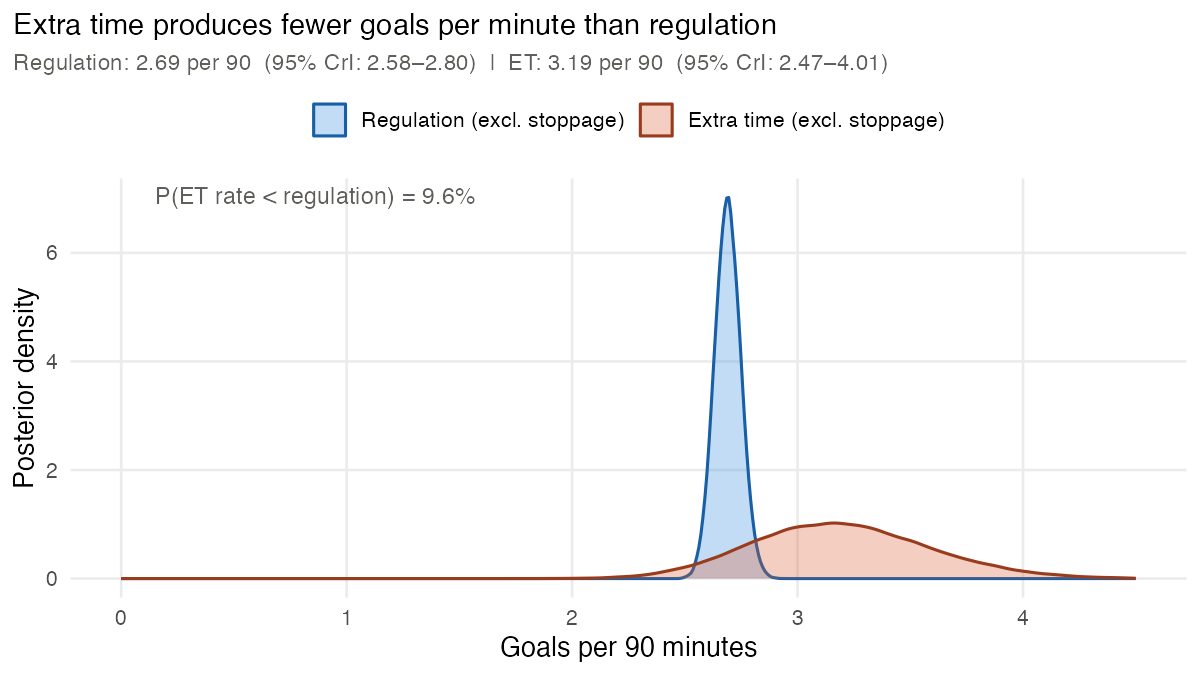
Regulation vs. extra time goal rate, posterior densities with 95% credible intervals.
By Josh Fjelstul, PhD
Let's also look at goals scored in stoppage time — the minutes added on after each half. We can report how many goals there were, but we can't calculate a rate because we don't know how much stoppage time there was after each half. In regulation stoppage time (both halves), there were 83 goals across 832 matches. In extra time stoppage time there were 3 goals across 60 matches. That's 10% versus 5%. Not a substantively or statistically meaningful difference.
Question 2: How often does extra time actually decide the match?
Second, let's look at how often extra time is decisive. Of the 60 matches that reach extra time, 28 were decided by a goal scored in extra time, and the other 32 went to penalties. That's 46.7%.
For this question, and the next one, we're estimating a percentage rather than a rate, so we use a different prior: Beta(3, 3). It's a symmetric distribution centered at 50%. This encodes no starting opinion about whether extra time usually settles things or not — we'll let the data tell us.
We get a point estimate of 47%, with a credible interval of [35.1%, 59.0%]. That's a pretty wide range. The probability that extra time is decisive (that this rate is greater than 50%) is only 31.2%. That's evidence against the argument that extra time is decisive. But that probability that extra time decides at least a third of matches is 98.8%.
So, the argument that we should get rid of extra time because it's rarely decisive rests on a false assertion. Extra time is frequently decisive.
Question 3: If a goal is scored, does it actually win the match?
Third, let's look at whether scoring an extra time goal is actually decisive. Among the 28 matches decided in extra time, we'll identify the team that scores first and check whether that team goes on to win. 27 of 28 first-scorers win — a striking 96%. But with a sample that small, there's a huge amount of uncertainty. The Bayesian estimate is more conservative: the estimated mean is 88.2% and the 95% credible interval is [75.7%, 96.6%]. Regardless of the sample size, the evidence is overwhelming — we can say with more than 98% confidence that scoring first in extra time wins the match more than three-quarters of the time.
Robustness and limitations
All of these findings are robust to weakening the priors. If I swap the Gamma(2, 60) prior for a much flatter Gamma(1, 30), and the Beta(3, 3) prior for a flatter Beta(1.5, 1.5), the estimates change by less than one percentage point.
There are some limitations to this analysis. In modeling goal rates, I've treated all matches — from the 1930s through the 2020s — as draws from one shared scoring rate, which almost certainly understates true match-to-match variation. The credible intervals are probably a bit too narrow. I'm also assuming that goals happen independently of each other within a match. That's certainly not true — a team's tactics usually shift once they're ahead or behind. But even with these caveats, the evidence is clear.